
Orchestration, not intervention
Most organisations do not have an execution problem.
They have a system problem.
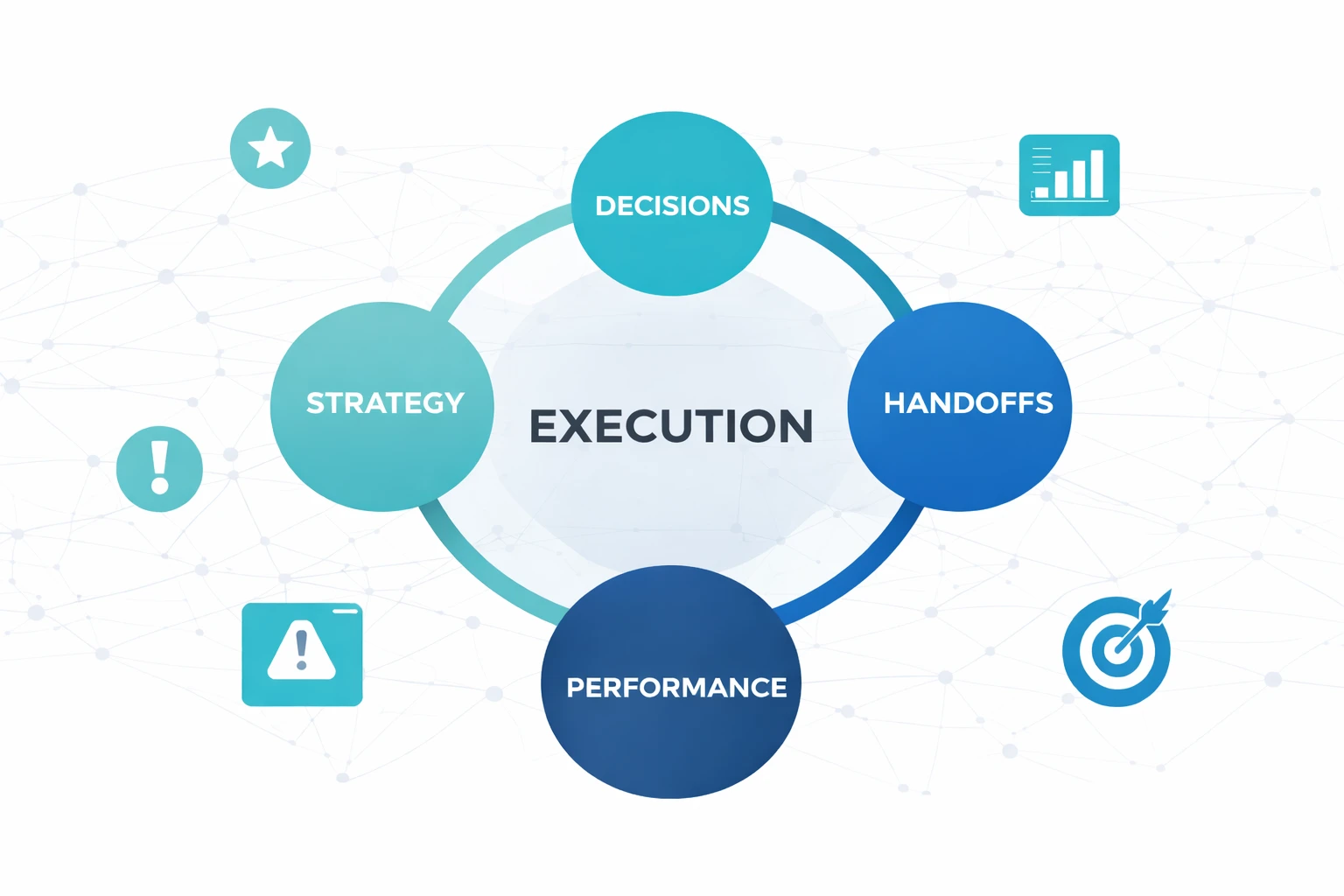
Work crosses functions. Decisions cross boundaries. Performance depends on how these connections hold. When they do not, performance erodes quietly and then expensively.
Kaleidoscope designs how execution works as a system.
The real execution problem
Execution rarely fails where leaders expect.
It does not fail because people do not care.
It does not fail because strategy is unclear.
It fails because:
- Decisions are made but not embedded
- Handoffs rely on goodwill instead of design
- Signals arrive too late to matter
- Improvements are delivered but decay
Leaders feel the impact long before they can prove the cause.
This is not an effort issue.
It is a system failure.
Most organisations do not have an execution problem.
They have a system problem.
Work crosses functions. Decisions cross boundaries. Performance depends on how these connections hold. When they do not, performance erodes quietly and then expensively.
Kaleidoscope designs how execution works as a system.
Signals Drive Execution
Execution rarely fails from lack of effort.
It fails when the right signals do not reach the right decisions in time.
Most organisations generate more data than they can interpret.
Noise overwhelms insight.
Escalation becomes reactive.
Performance deteriorates quietly before anyone can trace the cause.
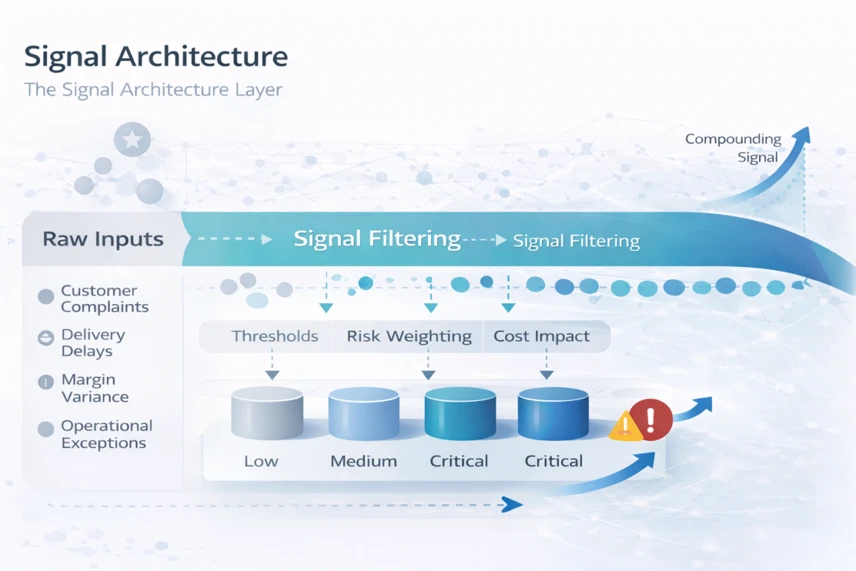
We design the signal architecture that ensures:
- Critical performance data is visible early
- Patterns are recognised before they become crises
- Risk is weighted deliberately, not emotionally
- Thresholds trigger escalation by design
- Ownership activates at the right moment
Signals move from raw input to prioritised action through a structured layer:
Raw Inputs → Filtering → Risk & Impact Weighting → Priority Thresholds → Escalation
When signals are architected, response becomes disciplined.
When response is disciplined, performance becomes predictable.
Ready to structure your signal architecture?
Decisions Hold Performance Together
Most execution breakdowns are decision failures. Not weak strategy.
Not lack of commitment. Unclear ownership.
Escalation without structure.
No decision memory.
Work crosses functions. Decisions cross boundaries.
Without governance, performance fragments.
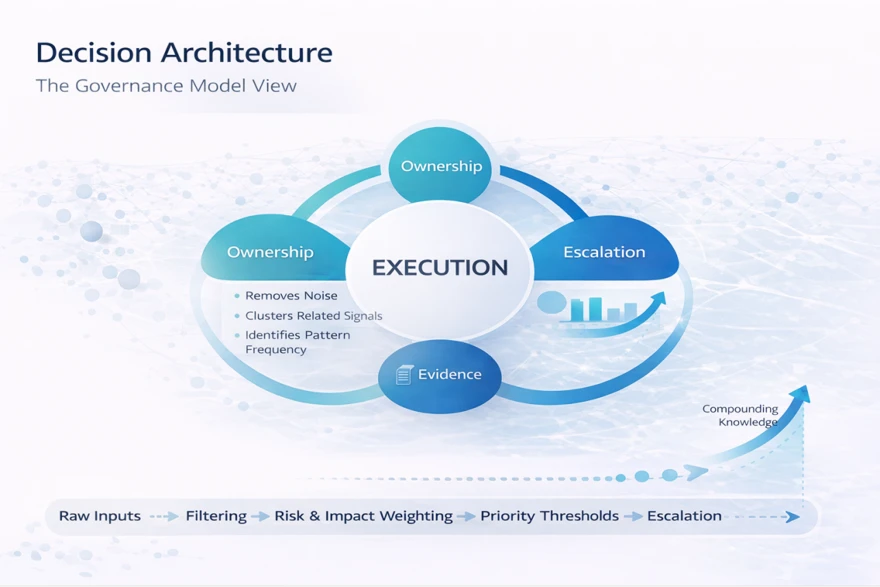
We design decision architecture that ensures:
- Every critical decision has a defined owner
- Escalation logic is structured across functions
- Evidence informs action
- Decisions are documented and revisited
- Learning compounds over time
Ownership → Evidence → Escalation → Decision Memory
When governance is deliberate, execution becomes reliable.
Ready to strengthen your decision architecture?
Execution & Handoff Orchestration
The Workflow Architecture View
Execution breaks at the point of transfer.
A decision is made.
A task is agreed.
Then ownership blurs.
Work moves.
Accountability does not.
Performance erodes in the space between teams.
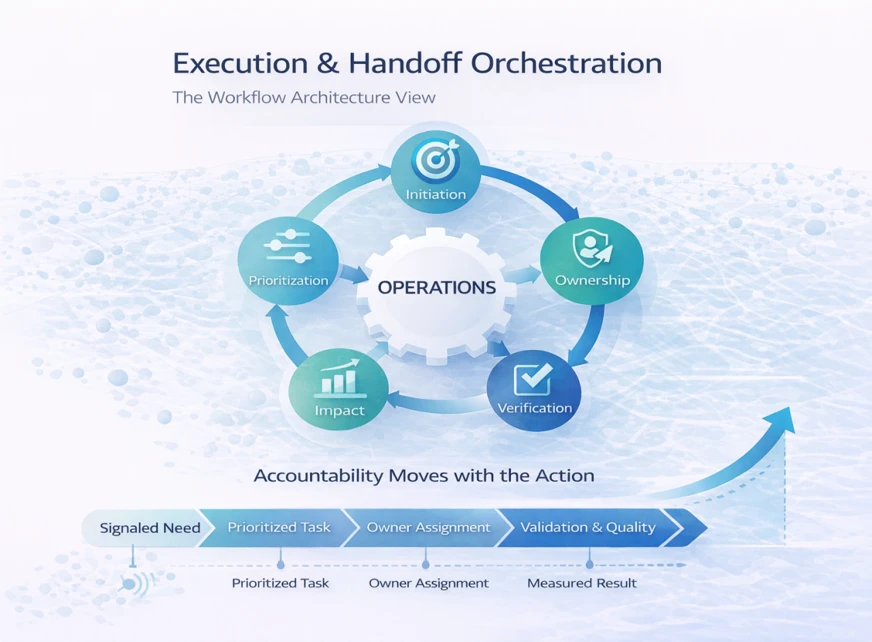
We design workflow architecture so accountability travels with the action.
What This Architecture Ensures
- A signaled need becomes a defined task
- A defined task has a named owner
- Ownership carries through validation
- Validation links to measurable result
- Results feed learning back into the system
Signal → Prioritise → Assign → Validate → Measure
Handoffs become structured.
Ownership becomes visible.
Execution holds end to end.
Ready to stabilise execution across handoffs?
What orchestration actually means
Orchestration is the discipline of designing how execution works.
It connects:
- What leaders intend
- How decisions are made
- How work flows across teams
- How performance is governed and learned from
Orchestration is not coordination. It is system design.
The Orchestration Loop
Execution becomes reliable through a deliberate progression.
See the System
Make handoffs, decision points, and failure patterns visible.
Fix what matters most
Prioritise the few breakdowns driving cost or instability.
Embed and scale
Turn fixes into governance and standard work so they hold.
The orchestration capabilities
Orchestration becomes real through a small number of core capabilities.
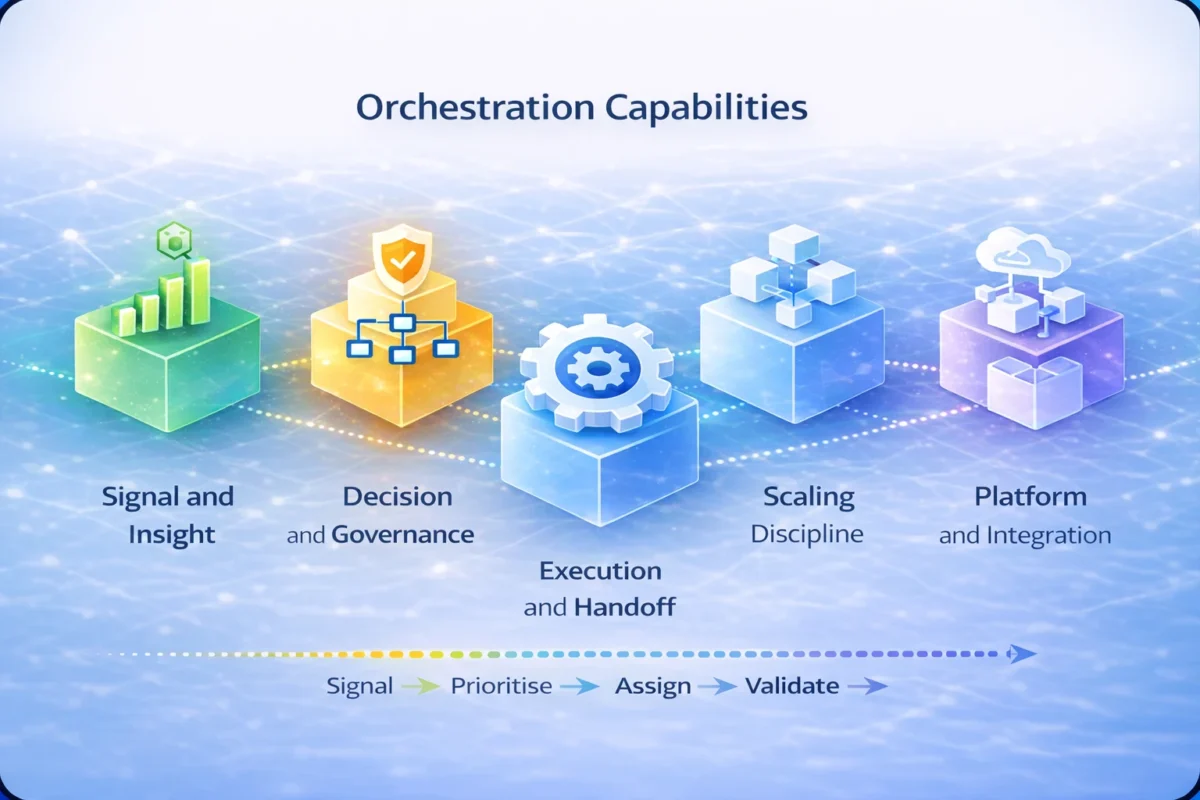
Signal and Insight
Performance signals are captured and acted on in time.
Decision and Governance
Decisions are owned, recorded and governed.
Execution and Handoff
Work flows across functions without informal coordination.
Scaling Discipline
Standards and patterns extend beyond individuals.
Platform and Integration
Execution is sustained through a shared backbone.
Orchestration Is Designed
Execution improves temporarily when effort increases. It improves permanently when structure changes. Orchestration becomes embedded through three deliberate design layers.
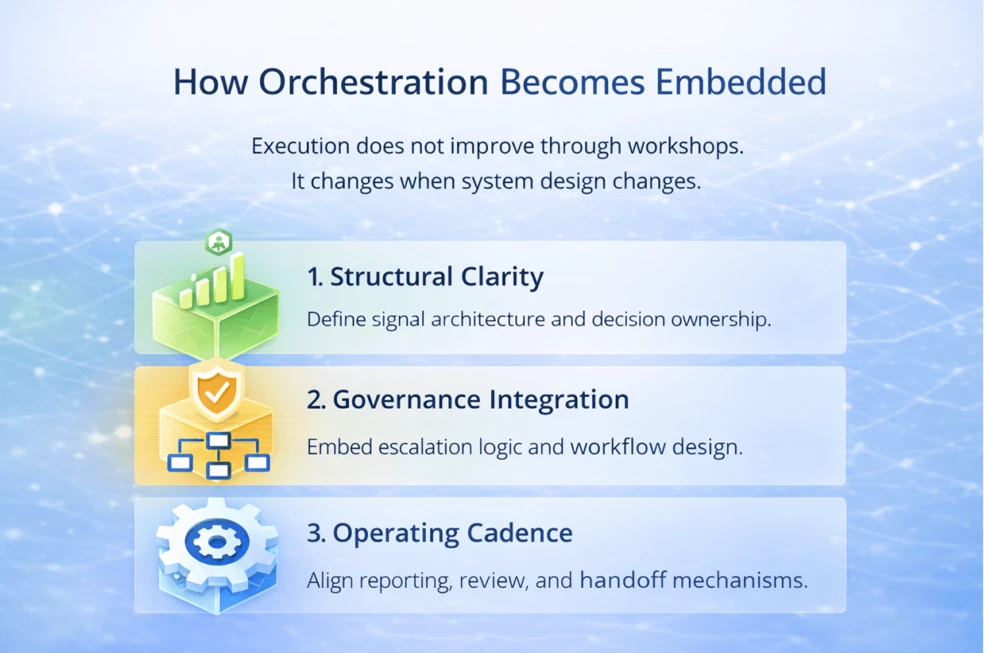
1. Structural Clarity
Performance begins with visibility.
Signals are defined.
Decision ownership is explicit.
Critical breakdown points are named and prioritised.
Without clarity, governance drifts.
2. Governance Integration
Escalation logic is structured across functions.
Decision rights are documented.
Workflow design replaces informal coordination.
Governance moves from conversation to architecture.
3. Operating Cadence
Review rhythms reinforce accountability..
Handoffs are defined, not assumed.
Measurement connects back to ownership..
Execution becomes reliable because the system supports it.
What makes this different
Kaleidoscope is designed to avoid common execution traps.
Not:
- Not advisory dependency.
- Not transformation theatre
- Not tool first optimisation.
- Not pilots disconnected from work design.
Instead:
- Discipline before automation
- System design before optimisation
- Governance before scale
Execution becomes something the organisation owns.
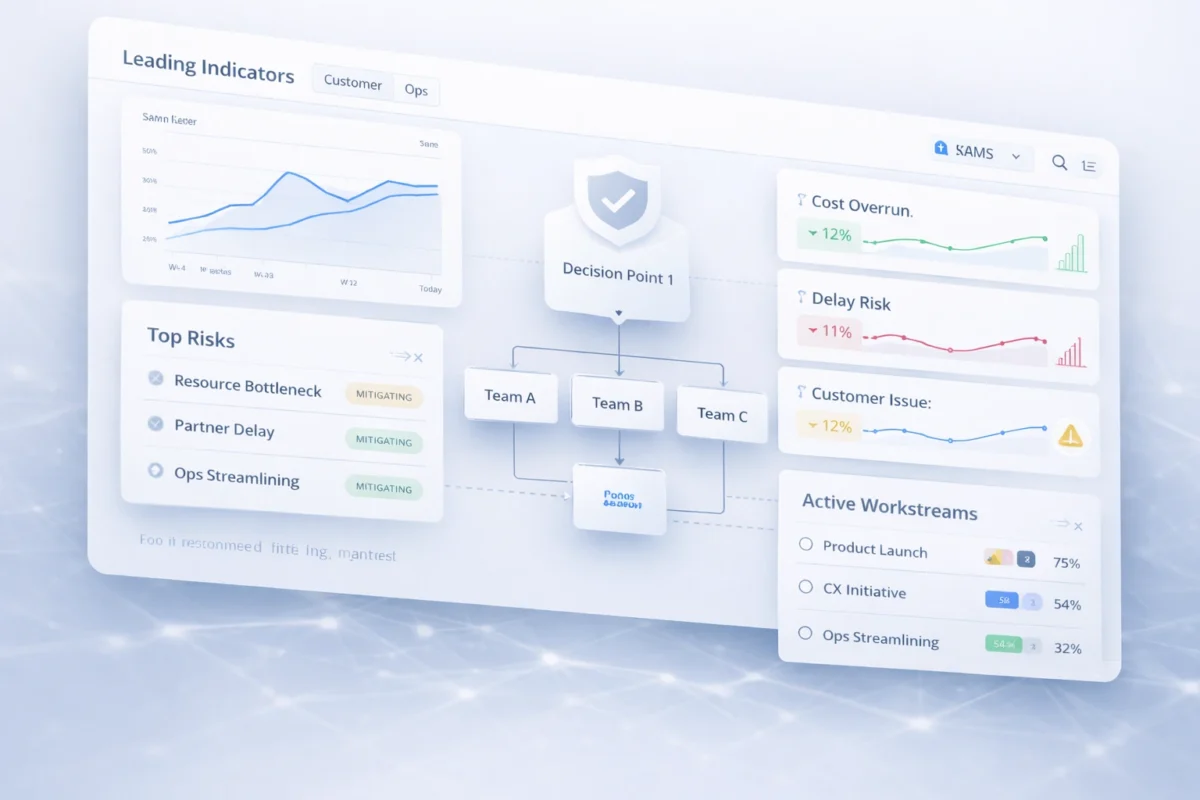
Where KIMS Fits
Orchestration does not hold in slides or memory.
KIMS is the execution backbone that keeps orchestration running.
- Decisions are recorded and governed
- Workflows are embedded into daily execution
- Evidence and learning accumulate
KIMS is not another platform.
It is the operating memory of execution.
How to start
Serious execution improvement does not begin with speed.
It begins with clarity leaders can trust.
Most organisations start with a short diagnostic to see where execution is leaking and where orchestration will matter most.
