
Kaleidoscope Information Management System – KIMS™
The execution backbone behind orchestration
Orchestration does not hold in slides or memory. It holds in a system.
KIMS is the system that keeps execution running when attention moves on.
Why orchestration needs a system
Most leaders know what must improve. What is missing is continuity.
Execution degrades when:
- Decisions are made but not recorded
- Governance lives in meetings
- Workflows span disconnected tools
- Evidence disappears with role changes
- Learning resets with each initiative
Without a system, orchestration is intent.
With a system, it becomes operating reality.

What KIMS is (and is not)
KIMS is not:
- A productivity tool
- A reporting dashboard
- A document repository
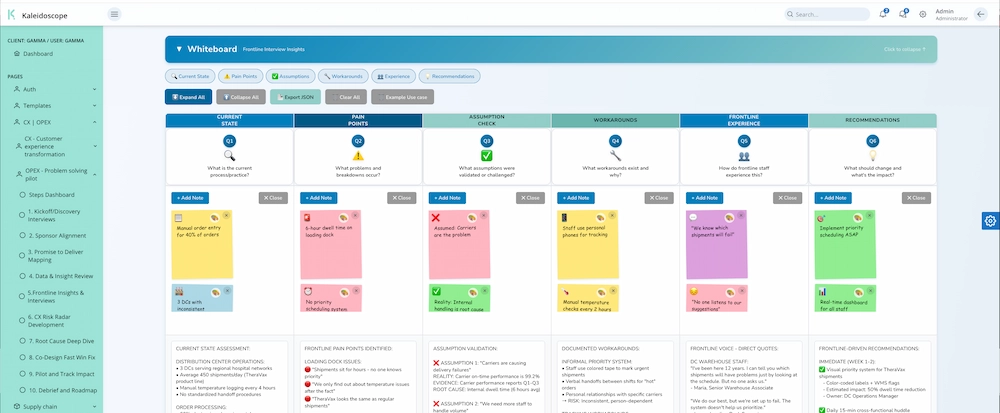
KIMS is the operating memory of execution.
It captures:
- What was observed
- What was decided
- Who owns what
- How work is meant to run
- What actually happened
Execution becomes traceable.
Accountability becomes durable.
What KIMS actually does
KIMS embeds orchestration into daily work through four core functions.
Governance
Decision rights, approvals, and escalation logic are explicit.
Orchestrated workflows
Templates translate insight into consistent cross functional execution.
Evidence capture
Observations, decisions, and outcomes are recorded in context.
Learning at scale
Improvement compounds instead of resetting.
Where KIMS fits in the orchestration model
KIMS underpins every stage of the Orchestration Loop.
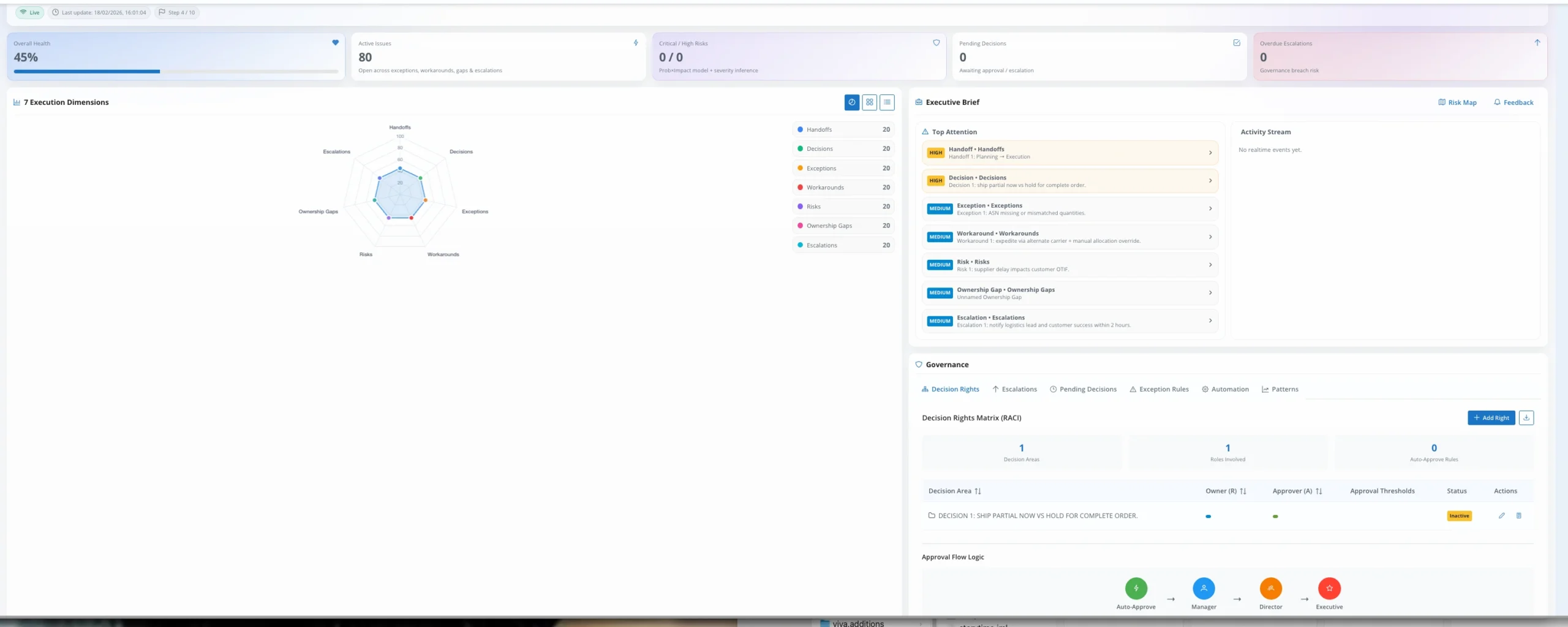
See the system
Handoffs, decision points, and performance signals become visible.
Fix what matters most
Prioritisation is anchored in evidence rather than opinion.
Embed and scale
Changes are translated into governance and standard work so performance holds.
Without KIMS, orchestration relies on attention.
With KIMS, it relies on design.
AI, applied deliberately
KIMS applies AI only where it strengthens execution.
AI supports:
- Pattern recognition across signals and outcomes
- Prioritisation of execution risks
- Consistency in documentation and workflow application
AI does not replace judgement or accountability.
Discipline comes first.
Ownership and control
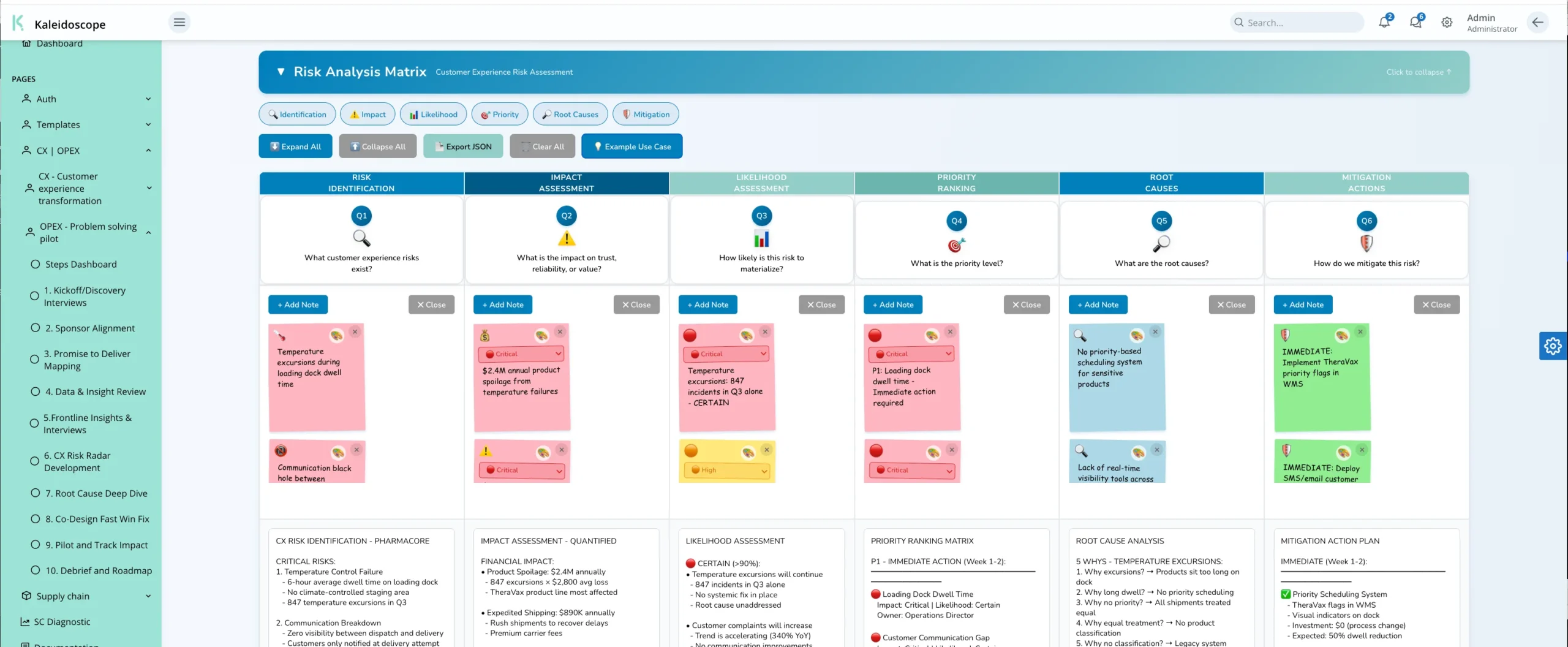
KIMS is built for organisations that want to own execution, not outsource it.
Team Operations
Teams run the workflows.
Decision Ownership
Leaders own the decisions.
Knowledge Retention
The organisation retains execution memory.
Execution logic lives in the system, not in consultants or individuals.
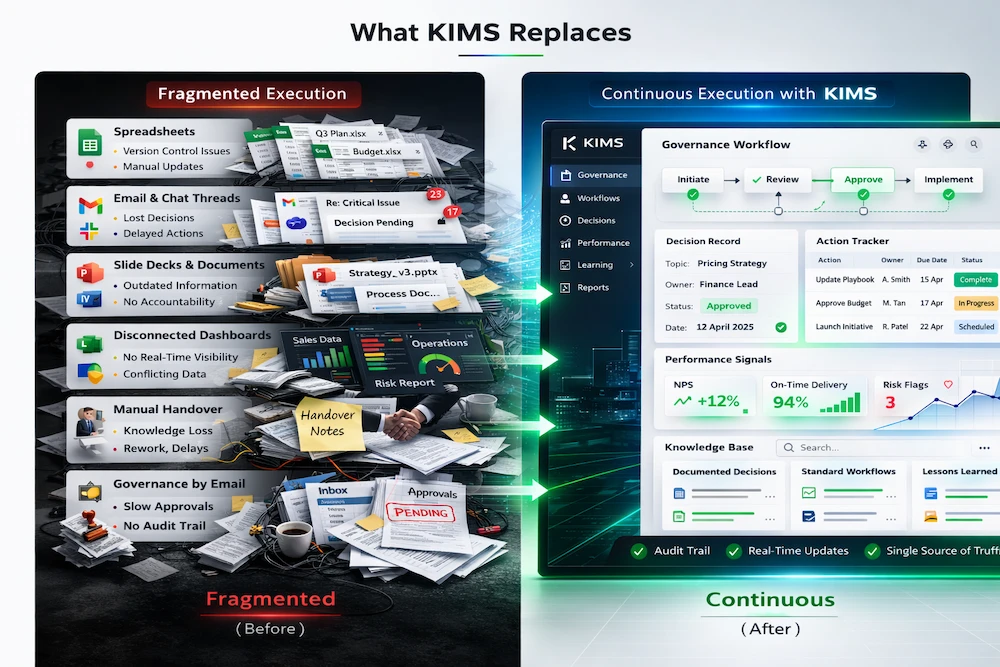
What KIMS replaces
KIMS removes the need to rely on:
- Slide decks as operating memory
- Informal handovers
- Spreadsheet based governance
- Repeated re diagnosis of the same problems
It replaces fragmentation with continuity.
How Access Is Structured
KIMS access reflects the scope of orchestration being embedded.
Organisations typically begin with one of four models:
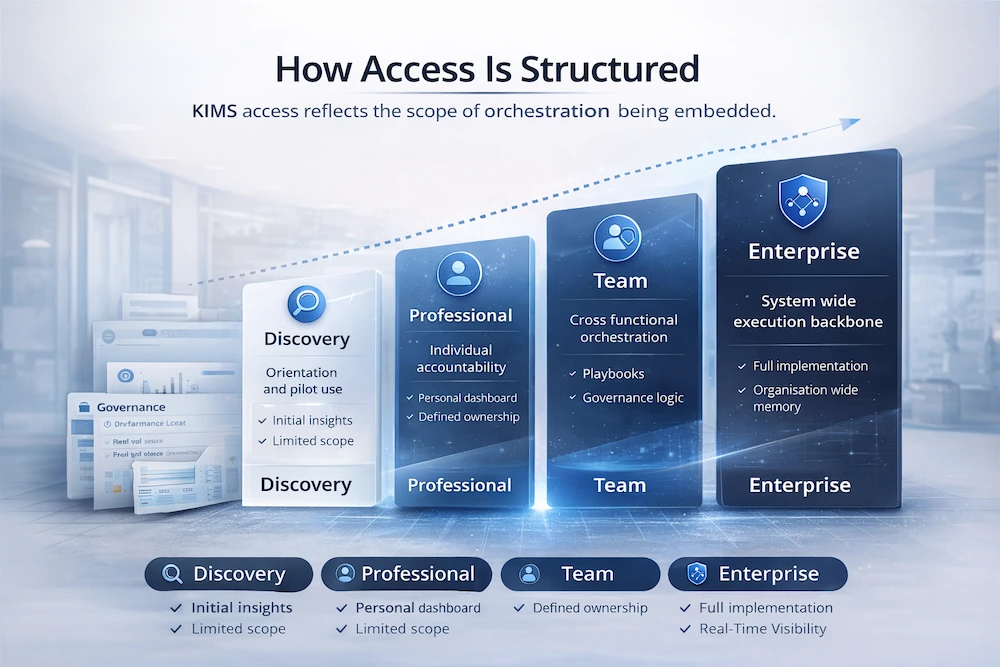
Discovery
Orientation and pilot use
Professional
Individual accountability
Enterprise
System wide execution backbone
Access expands deliberately as orchestration proves its value.
Seeing KIMS in action
KIMS is best understood in real work.
Most leaders begin by reviewing:
- A governance workflow
- A live execution template
- A decision record in context
From there, the system becomes self evident.
Execution systems are adopted deliberately.
